
About the ATR Adaptive T3 Indicator
The ATR Adaptive T3 Indicator for MT5 blends volatility and trend into one smart trading tool.
It uses an adaptive T3 moving average that responds to changes in the Average True Range, so the line stays smooth in quiet markets and reacts faster when volatility kicks in.
This makes it very useful for timing entries and exits without getting chopped up by minor price noise.
In trending conditions, the line hugs price tightly and slopes in the direction of the move. During ranges, it flattens out and signals that momentum is fading.
For intraday traders, this helps you focus on real moves instead of every small fluctuation.
You can also combine it with basic price action or support and resistance zones to build a complete trading plan.
Free Download
Key Features
- Adaptive T3 line that adjusts its sensitivity based on ATR volatility conditions.
- Smooth moving average behavior during quiet markets and faster reaction during strong moves.
- Ideal for London and New York session trading when volatility is higher.
- Can be combined with other indicators such as volume, oscillators, or support and resistance.
Indicator Chart
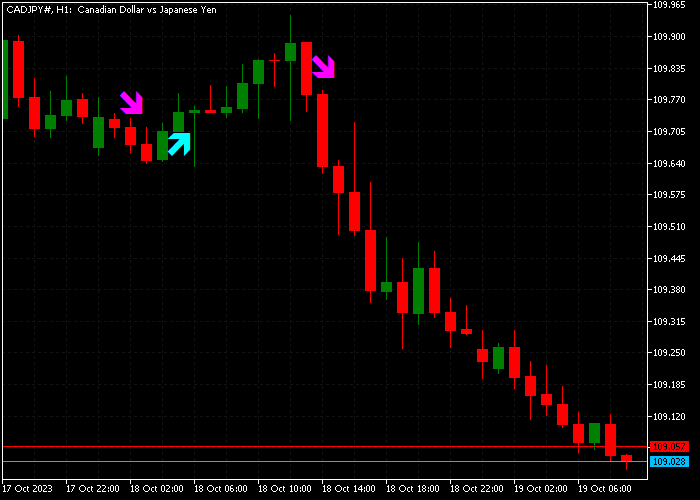
On a standard chart, the ATR Adaptive T3 Indicator for MT5 appears as a colored T3 line following price action.
When the line is green and stays below the candle, it highlights bullish trend conditions.
When the line is magenta above the candle, it points to a bearish environment.

Guide to Trade with the ATR Adaptive T3 Indicator
Buy Rules
- Look for the ATR Adaptive T3 line to turn green and start sloping upward with price trading above it.
- Wait for a minor pullback where candles approach the green line without breaking key support levels.
- Open a buy trade when a bullish candle closes above the green line in line with the trend direction.
- Prioritize setups during active sessions when volatility supports trend continuation moves.
Sell Rules
- Wait for the ATR Adaptive T3 line to turn magenta and slope downward while price trades below it.
- Watch for a retracement where candles move back toward the magenta line near a resistance area.
- Open a sell trade when a bearish candle closes below the magenta line with the trend still intact.
- Focus on signals that occur during the most liquid hours to avoid slow, choppy markets.
Stop Loss
- For buy trades, place the stop loss below the most recent swing low or support zone near the green line.
- For sell trades, set the stop loss above the latest swing high or resistance area close to the magenta line.
- You can also use a multiple of the current ATR value to size the stop distance in volatile conditions.
Take Profit
- For buy trades, close the trade when the line turns magenta.
- For sell trades, exit the trade when the line turns green.
- Alternatively, exit the trade for a fixed profit target.
ATR Adaptive T3 Indicator MT5 Forex Strategy with Elder Impulse System
This strategy combines the ATR Adaptive T3 Indicator with the Elder Impulse System Indicator to create a clean trend continuation method.
The ATR Adaptive T3 Indicator acts as the main trend filter.
A green upward sloping line indicates a bullish trend, while a magenta downward sloping line indicates a bearish trend.
The Elder Impulse System confirms entry timing by combining trend and momentum into a single signal.
Green impulse blocks indicate bullish momentum aligned with the trend, while red blocks indicate bearish momentum.
This strategy is suitable for M15 and H1 charts where trends develop with enough structure and impulse signals remain reliable during active sessions.
Buy Entry Rules
- Wait for the ATR Adaptive T3 line to turn green and slope upward.
- Confirm that price is trading above the indicator.
- Wait for a green impulse block from the Elder Impulse System.
- Enter a buy trade at the close of the signal candle.
- Place stop loss below the most recent swing low or below the ATR Adaptive T3 line.
- Exit the trade when the Elder Impulse System prints a red block.
- Alternatively, exit when the ATR Adaptive T3 line changes from green to magenta.
Sell Entry Rules
- Wait for the ATR Adaptive T3 line to turn magenta and slope downward.
- Confirm that price is trading below the indicator.
- Wait for the first red impulse block from the Elder Impulse System.
- Enter a sell trade at the close of the signal candle.
- Place stop loss above the most recent swing high or above the ATR Adaptive T3 line.
- Exit the trade when the Elder Impulse System prints a green block.
- Alternatively, exit when the ATR Adaptive T3 line changes from magenta to green.
Case Study 1: USDCHF M15 Buy Trade
On USDCHF M15, the ATR Adaptive T3 line turned green and started sloping upward, confirming a bullish trend.
Price remained above the line and respected it during small pullbacks.
A green impulse block appeared on the Elder Impulse System, which triggered the buy entry.
The trade was opened at the close of that candle.
The stop loss was placed below the recent swing low and just under the ATR Adaptive T3 line.
After several bullish candles, a red impulse block formed.
The long trade was closed because the Elder Impulse System Indicator signaled a shift in momentum.
Case Study 2: EURAUD H1 Sell Trade
On EURAUD H1, the ATR Adaptive T3 line turned magenta and sloped downward, confirming bearish conditions.
Price stayed below the indicator and continued trending lower.
The first red impulse block appeared on the Elder Impulse System, which triggered the sell entry.
The position was opened at the candle close.
The stop loss was placed above the recent swing high and slightly above the ATR Adaptive T3 line.
Later, the ATR Adaptive T3 line turned green.
The short trade was closed because the ATR Adaptive T3 Indicator signaled a change in trend direction.
Download Now
FAQ
Can I use the ATR Adaptive T3 line as a trend filter with other indicators?
Yes, many traders use the green or magenta line as a primary trend filter and then rely on oscillators or price patterns for entry timing.
For example, only take long signals from an oscillator when the line is green, and only take short signals when the line is magenta.
How should I adjust the settings when market volatility changes?
When markets become more volatile, you can slightly shorten the period so the ATR Adaptive T3 reacts faster to price moves.
In quiet or choppy periods, a slightly longer period can help filter out noise.
Summary
The ATR Adaptive T3 Indicator offers a flexible way to follow trend direction while accounting for volatility shifts.
The green and magenta color changes make it easy to see when buyers or sellers are in control, and the adaptive T3 calculation keeps the line smooth without lagging too far behind price.
There is room to refine performance by combining the ATR Adaptive T3 with price action confirmation and strict risk management.
Used as the main trend filter, it can help traders stay on the right side of the market and avoid many low probability counter trend trades that often hurt performance over the long run.