About the ATR Indicator
The Average True Range (ATR) Indicator for MT5 measures market volatility by calculating the average price range over a set period, typically 14.
High ATR readings signal expanding volatility where price swings grow larger, while low readings indicate contracting ranges and quieter markets.
Traders use this information to adapt position sizing, stops, and targets to current conditions.
During news events or breakouts, you’ll see ATR spikes signaling wider stops are needed.
In ranging markets, low ATR values call for tighter risk management.
Default 14-period balances responsiveness and smoothing, but scalpers drop to 7-10 while swing traders extend to 20-50 periods.
Free Download
Key Features
- Measures true average price range including gaps for accurate volatility.
- Single blue line shows expanding/contracting market conditions clearly.
- The default 14-period setting works across all forex pairs and timeframes.
- Identifies breakout conditions when ATR spikes above the recent average.
Indicator Chart
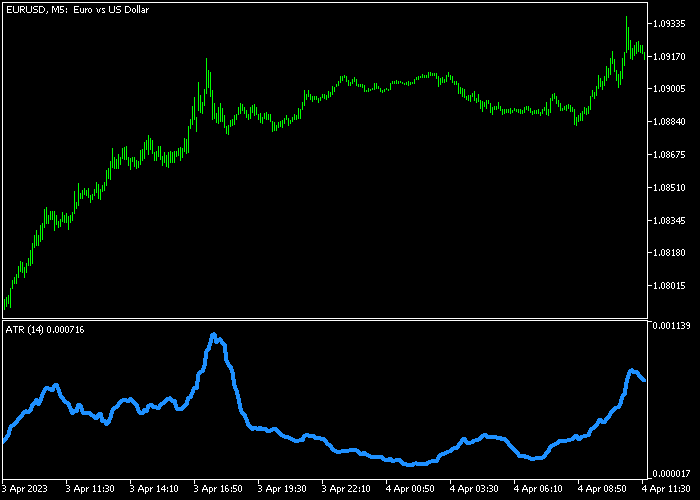
The ATR Indicator plots a blue line in a sub-window below price action.
Rising lines indicate growing volatility with larger candles forming on the main chart.
Falling lines show contracting ranges where price movement slows significantly.
Sharp spikes often precede major breakouts or news-driven moves.
Prolonged low readings signal range-bound conditions ideal for scalping small moves.

Guide to Trade with the ATR Indicator
Buy Rules
- Enter long positions when ATR shows normal to elevated volatility levels.
- Confirm entry with price action or other indicators during ATR expansion.
- High ATR readings justify wider stops but signal larger potential moves.
- Avoid new buys when ATR hits multi-month lows indicating range exhaustion.
Sell Rules
- Take short entries during ATR expansion confirming breakout momentum.
- Low ATR followed by a sudden spike often precedes sharp bearish moves.
- Stable moderate ATR suits range selling near resistance with tight targets.
- Skip shorts when ATR remains extremely low with no volatility expansion.
Stop Loss
- Set stops at 1.5-2x current ATR value from entry for most conditions.
- In high volatility (ATR > recent average), use 2.5-3x ATR for breathing room.
- Low volatility markets need tighter 1x ATR stops to maintain risk-reward.
Take Profit
- First target at 2x ATR from entry during normal volatility conditions.
- High ATR readings justify 3-4x ATR targets for breakout continuation.
- Scale out half position at 1.5x ATR, trail remainder using 2x ATR stops.
- Exit fully when the ATR contracts sharply against your position direction.
Download Now
FAQ
What ATR period setting works best for scalping?
Scalpers use 7-10 period ATR for responsive volatility readings on M1-M15 charts. This catches short-term range expansion quickly.
Test 7 first, then adjust based on pair volatility and your timeframe preference.
Should I trade when ATR shows extremely low readings?
Low ATR signals range-bound conditions perfect for reversal strategies near support/resistance.
Avoid trend following during prolonged low ATR periods. Wait for expansion before taking directional breakout trades.
How much should I multiply the ATR for stop loss placement?
1.5x ATR works for scalping tight stops. 2x ATR suits day trading most pairs.
2.5-3x ATR needed for volatile pairs like GBPJPY during news.
Summary
The ATR Forex Indicator delivers precise volatility measurements essential for professional risk management.
Blue line spikes reveal expansion for bigger targets, while contractions signal tight range trading opportunities.
Single period adjustment makes it simple yet powerful across all MT5 markets.
Use ATR multiples for dynamic stops/targets that adapt to current conditions automatically.
It’s an essential tool for position sizing and breakout confirmation.