About the Tom Demark Moving Average Indicator
The Tom Demark Moving Average indicator for MT5 is a trend-following tool designed by Tom Demark.
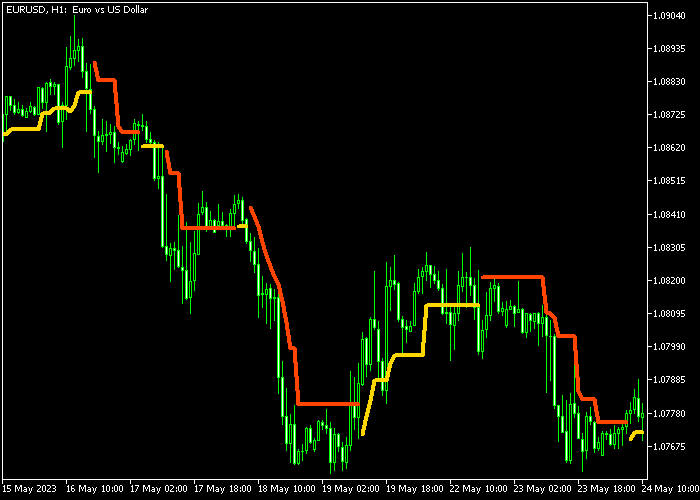
It highlights market direction and potential reversals using a color-changing moving average line plotted directly on the price area.
The indicator switches between two colors to reflect trend conditions.
A yellow line signals bullish momentum and suggests that buyers control the market.
An orange line indicates bearish pressure and shows that sellers dominate the current trend.
Because the indicator reacts to shifts in price direction, traders often use it to follow trends and detect potential reversal points.
The color changes also allow traders to manage positions or reverse trades when the market direction changes.
Free Download
Tom_Demark_Moving_Average.mq5 Indicator (MT5)
Key Features
- A trend-following indicator created by Tom Demark.
- Displays a two-colored moving average line on the price area.
- Yellow line signals bullish market conditions.
- Orange line signals bearish market conditions.
- Provides stop and reverse style trading signals.
- Adjustable parameters for trend and smoothing periods.
Indicator Chart
The Tom Demark Moving Average indicator appears as a colored signal line over the price area.
When the line turns yellow, it reflects bullish momentum, while an orange line indicates bearish market pressure and potential sell opportunities.
Guide to Trade with Tom Demark Moving Average
Buy Rules
- Watch for the moving average line to change to yellow.
- Confirm that price begins moving above the indicator line.
- Open a buy trade once the bullish color appears.
- Hold the position while the yellow trend line remains active.
Sell Rules
- Watch for the moving average line to change to orange.
- Confirm that price begins moving below the indicator line.
- Open a sell trade once the bearish color appears.
- Maintain the trade while the orange line continues.
Stop Loss
- Place the stop loss slightly below a recent support level for buy trades.
- Place the stop loss slightly above a recent resistance level for sell trades.
- Another approach is to position the stop behind the most recent price pullback.
- Always adjust the stop distance so the risk fits your trading plan.
Take Profit
- Close the buy trade when the moving average changes from yellow to orange.
- Close the sell trade when the moving average switches from orange to yellow.
- Another option is to exit the trade near the next key price reaction area.
- Some traders prefer trailing the stop to lock in profits as the trend develops.
Tom DeMark Moving Average Forex Scalping Strategy for MT5
This scalping strategy combines the Tom DeMark Moving Average Indicator with the Dark Inversion Indicator to build a fast and reactive intraday system.
It is designed for EURUSD, GBPUSD, and XAUUSD (Gold), focusing on short momentum bursts during London and New York sessions.
The Tom DeMark Moving Average defines trend direction using a structural price logic rather than a standard smoothing method.
A yellow line indicates bullish trend conditions, while an orange line signals bearish structure.
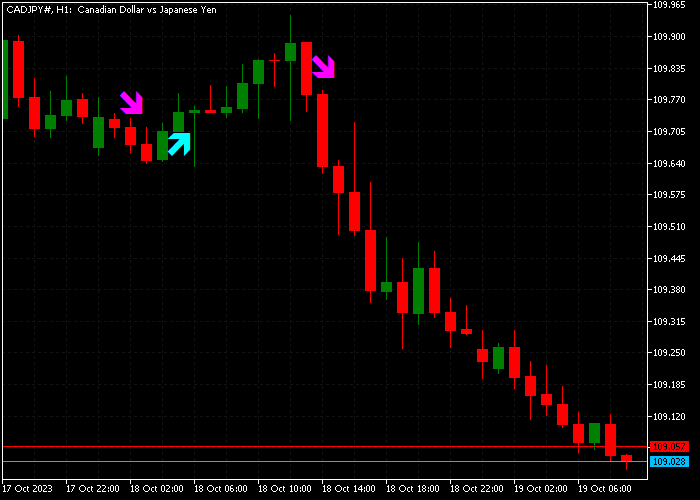
The Dark Inversion Indicator provides timing signals through arrows.
A green arrow signals a potential buy opportunity, while a red arrow indicates a potential sell setup.
These signals are most effective when they appear in alignment with the underlying trend direction defined by the DeMark moving average.
This strategy works best on M1 to M5 charts and performs strongly during London and New York sessions where liquidity supports fast directional moves.
Buy Entry Rules
- Confirm that the Tom DeMark Moving Average is yellow, indicating bullish trend structure.
- Wait for a green arrow from the Dark Inversion Indicator to appear.
- Enter a buy trade after a small pullback when price remains above the DeMark moving average.
- Place the stop loss below the most recent micro swing low or just under the DeMark line depending on volatility.
- Take profit at 10–25 pips on EURUSD and GBPUSD, or 20–40 points on Gold, or exit when a red arrow appears or price closes below the DeMark line.
Sell Entry Rules
- Confirm that the Tom DeMark Moving Average is orange, indicating bearish trend structure.
- Wait for a red arrow from the Dark Inversion Indicator to appear.
- Enter a sell trade after a retracement when price stays below the DeMark moving average.
- Place the stop loss above the most recent swing high or just above the DeMark line depending on volatility.
- Take profit at 10–25 pips on EURUSD and GBPUSD, or 20–40 points on Gold, or exit when a green arrow appears or price closes above the DeMark line.
Case Study 1: EURUSD M5 London Session Buy
During the London session on EURUSD M5, price transitioned from a short consolidation phase into a clear upward expansion.
The Tom DeMark Moving Average turned yellow and started to slope upward, confirming bullish structure.
Shortly after, the Dark Inversion Indicator printed a green arrow after a minor pullback into the DeMark line.
A buy trade was entered at the close of the confirmation candle while price remained above the moving average.
The stop loss was placed just below the DeMark line rather than a fixed pip distance, allowing flexibility during intraday volatility.
Price moved upward in a steady sequence of bullish candles and reached the scalping target zone efficiently.
The long trade was closed exactly when a red arrow appeared while price showed rejection near a minor resistance area and closed back below the DeMark moving average, confirming that bullish momentum had ended.
Case Study 2: XAUUSD (Gold) New York Session Sell
On XAUUSD during the New York session, price pushed into a resistance zone after a strong intraday rally.
The Tom DeMark Moving Average turned orange, signaling a bearish structural shift.
At the same time, the Dark Inversion Indicator printed a red arrow after a retracement into the DeMark line.
A sell trade was executed at the close of the signal candle while price stayed below the moving average.
The stop loss was placed above the most recent swing high instead of tightly above the indicator line due to Gold’s higher volatility profile.
Price dropped in a fast impulsive move and reached the target zone quickly.
The short trade was closed exactly when a green arrow appeared and price closed back above the DeMark moving average, confirming a full intraday reversal.
Download Now
Tom_Demark_Moving_Average.mq5 Indicator (MT5)
FAQ
Who developed the Tom Demark Moving Average indicator?
The indicator was developed by Tom Demark, a market analyst known for creating technical indicators that help identify trend changes and market turning points.
Which settings can be adjusted?
The indicator allows traders to modify the trend period, the simple moving average period, and the line style. These settings help adapt the indicator to different trading strategies.
Can this indicator be used as a standalone strategy?
Yes. Many traders use it as a standalone trend-following tool. Others combine it with support and resistance analysis or momentum indicators to confirm signals.
Summary
The Tom Demark Moving Average indicator offers a straightforward method for identifying market trends and potential reversals.
The color-changing moving average line allows traders to quickly recognize whether buyers or sellers control the market.
Because the indicator produces stop and reverse signals, traders can follow trends and adjust positions when the market direction changes.
This makes it useful for both short-term and longer-term trading approaches.
With simple visual signals and customizable settings, the indicator can help traders stay aligned with the dominant market direction while maintaining flexible risk management.