
About the Gaussian Filter Indicator
The Gaussian Filter Indicator for MT5 is a trend-following tool that smooths price data while maintaining responsiveness to market changes.
It is based on advanced Gaussian filtering techniques, allowing traders to reduce noise without sacrificing accuracy.
Unlike standard moving averages, this indicator supports higher-order calculations, giving it the ability to adapt more precisely to price movement.
It uses two main inputs, the calculation period and the filter order, which control how smooth or reactive the line becomes.
The indicator appears directly on the price area as a single line that changes color depending on trend direction.
This makes it easy to spot momentum shifts and follow ongoing trends with better timing.
Free Download
Key Features
- Advanced Gaussian filtering for smoother trend analysis.
- Supports adjustable order settings for precision control.
- Color-changing line to reflect market direction.
- Reduces market noise compared to standard moving averages.
- Simple visual signals for trend continuation and reversal.
Indicator Chart
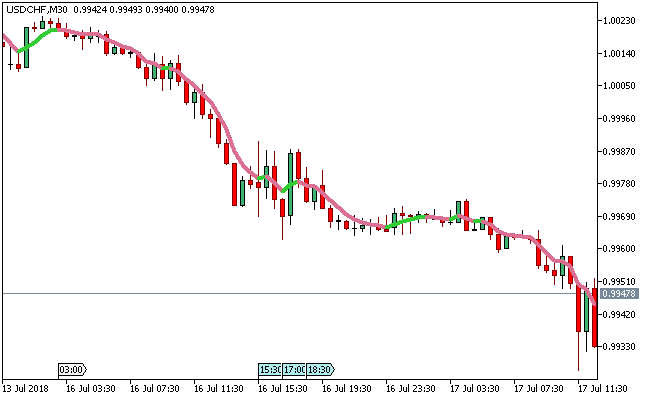
The Gaussian Filter Indicator appears directly on the price area as a smooth line that shifts between lime green and pale violet red.
The chart shows how the line follows price closely while filtering out minor fluctuations, highlighting trend direction and signal changes through its color transitions.
Guide to Trade with the Gaussian Filter Indicator
Buy Rules
- Wait for the indicator line to turn lime green.
- Confirm that the line is moving upward consistently.
- Check that price is aligned with bullish momentum.
- Enter a buy trade at the next candle open.
Sell Rules
- Wait for the indicator line to turn pale violet red.
- Confirm that the line is sloping downward.
- Ensure price action supports a bearish move.
- Enter a sell trade at the next candle open.
Stop Loss
- Place the stop loss a fixed number of pips below the entry for buy trades.
- Place the stop loss a fixed number of pips above the entry for sell trades.
- Adjust the stop as the trade moves in your favor to reduce exposure.
Take Profit
- Close buy trades when the indicator changes from green to red.
- Close sell trades when the indicator changes from red to green.
- Alternatively, target key price reaction zones.
MT5 Scalping Strategy Using Gaussian Filter Indicator
This scalping strategy combines the Gaussian Filter Indicator with the Simple Moving Average (SMA) to capture short-term directional moves on M1 and M5 charts.
The Gaussian Filter provides a smoothed trend line that reacts to price changes with reduced noise.
A lime green line reflects bullish structure, while a pale violet line reflects bearish conditions.
The SMA confirms the broader intraday bias.
A blue SMA line signals bullish trend strength, while an orange SMA line signals bearish structure.
Price alignment with the SMA helps filter trades in the direction of the dominant flow and avoids counter-trend entries.
This strategy is designed for fast execution during London and New York sessions on pairs such as EURUSD, GBPUSD, USDJPY, and XAUUSD.
Buy Entry Rules
- Confirm that the SMA line is blue, indicating a bullish intraday trend direction.
- Wait for the Gaussian Filter line to turn lime green.
- Enter a buy trade at the close of the signal candle on M1 or M5 charts.
- Place the stop loss below the most recent swing low or below the Gaussian Filter line if it is closer.
- Close the trade when the Gaussian Filter turns pale violet, showing a loss of bullish momentum.
- Alternative exit: close the trade when the SMA turns orange, indicating bearish trend transition.
Sell Entry Rules
- Confirm that the SMA line is orange, indicating bearish intraday trend direction.
- Wait for the Gaussian Filter line to turn pale violet.
- Enter a sell trade at the close of the signal candle on M1 or M5 charts.
- Place the stop loss above the most recent swing high or above the Gaussian Filter line if it is closer.
- Close the trade when the Gaussian Filter turns lime green, showing a shift toward bullish momentum.
- Alternative exit: close the trade when the SMA turns blue, indicating bullish trend transition.
Case Study 1
On EURUSD M5 during the London session, the SMA line turned blue after a steady upward sequence of candles.
Price remained above the moving average during a brief consolidation phase.
The Gaussian Filter switched to lime green and confirmed bullish continuation. A buy trade was opened at candle close.
The stop loss was placed below the most recent consolidation low that formed before continuation.
Two hours later, the Gaussian Filter turned pale violet, indicating a short-term bearish trend.
The long trade was closed for 22 pips.
Case Study 2
On XAUUSD M1 during a New York session expansion, the SMA line turned orange after a sharp rejection from intraday highs.
The Gaussian Filter shifted to pale violet, confirming bearish conditions.
A sell trade was opened at candle close and our stop loss was placed above the last rejection wick.
15 candles later, the SMA switched from orange to blue and the short trade was immediately closed for a small profit.
Download Now
FAQ
What makes the Gaussian Filter different from a moving average?
The Gaussian Filter uses advanced smoothing techniques that reduce lag while maintaining accuracy.
It reacts more efficiently to price changes than traditional moving averages.
How do the period and order settings affect performance?
The period controls sensitivity, while the order determines how smooth the line becomes.
Higher order values produce smoother results but slightly slower reactions.
Can this indicator be used on lower timeframes?
Yes, it performs well on lower timeframes, especially when combined with confirmation tools to filter out false signals.
Summary
The Gaussian Filter Indicator offers a refined approach to trend tracking by combining smoothness with responsiveness.
Its adaptive nature allows traders to follow market direction with reduced noise.
It fits a wide range of trading styles and works effectively across multiple timeframes.
The color-based signals make it easy to interpret without complex analysis.
When used alongside other tools, it can improve trade timing and provide more consistent results in both trending and changing market conditions.