About the Chaikin Volatility Oscillator
The Chaikin Volatility Oscillator for MT5 is a technical tool that measures changes in market volatility over time.
Comparing the difference between high and low prices highlights periods when volatility is expanding or contracting.
Traders often use the oscillator in combination with trend-following indicators to confirm market momentum and refine trade entries.
Rising values indicate increasing volatility, which can signal the start of a trend or a potential breakout, while falling values indicate decreasing volatility, often seen during consolidations.
It is suitable for all currency pairs and can be applied across multiple timeframes, making it flexible for scalping, intraday, or swing trading strategies.
Free Download
Key Features
- Measures market volatility by analyzing price range expansion and contraction.
- Visualizes periods of high and low volatility to support trade decisions.
- Best used alongside trend-following indicators for confirmation.
- Helps traders anticipate potential breakouts and trend changes.
Indicator Chart
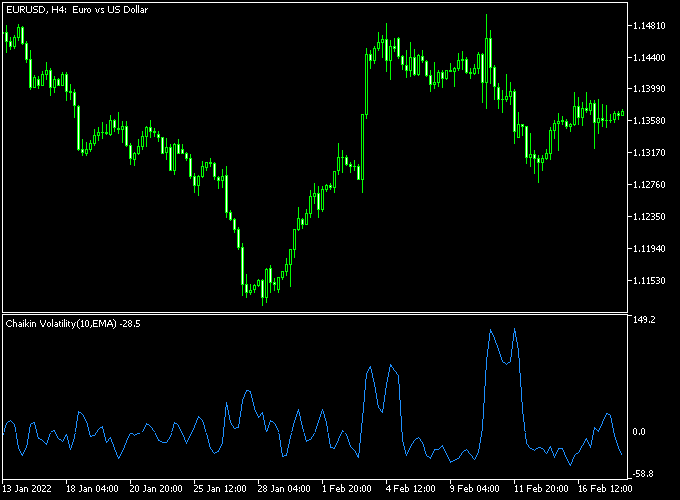
The Chaikin Volatility Oscillator appears beneath the main price movement as a fluctuating line.
The chart shows how spikes in volatility often precede price breakouts or strong trend moves, while periods of low volatility indicate consolidation zones.
Guide to Trade with Chaikin Volatility Oscillator
Buy Rules
- Look for rising volatility during an uptrend.
- Confirm that the price trend supports bullish momentum.
- Use additional trend-following indicators for entry confirmation.
- Open a buy trade when volatility expansion aligns with an uptrend.
Sell Rules
- Look for rising volatility during a downtrend.
- Confirm that price is showing bearish momentum.
- Use additional indicators to validate the sell signal.
- Open a sell trade when volatility expansion aligns with a downtrend.
Stop Loss
- Place stop losses slightly beyond the recent swing high for sell trades.
- Place stop losses slightly below the recent swing low for buy trades.
- Consider wider stops in high-volatility conditions to avoid premature exits.
Take Profit
- Close buy trades near the next resistance level or swing high.
- Close sell trades near the next support level or swing low.
- Exit trades early if volatility starts to contract against the trade direction.
- Optionally trail profits as volatility continues in favor of the trend.
MT5 Strategy Using Chaikin Volatility Oscillator
This strategy combines the Chaikin Volatility Oscillator with the 4 MAs Forex Signal Indicator to trade volatility expansion within a defined trend.
The approach focuses on moments when volatility increases in the direction of the trend.
Rising volatility signals that price is actively moving, while the moving average signals define whether the market is trending up or down.
This filters out slow conditions and keeps the focus on strong directional phases.
This strategy works best on M15 and H1 timeframes.
It fits traders who want clear rules with confirmation from both volatility and trend direction.
Buy Entry Rules
- Wait for a yellow arrow confirming an uptrend.
- Confirm that the Chaikin Volatility Oscillator is rising, showing increasing volatility during the uptrend.
- Enter a buy trade at the close of the confirmation candle.
- Place the stop loss below the most recent swing low.
- Close the trade when the Chaikin Volatility Oscillator starts to decline because volatility is weakening.
- Alternative exit: close the trade when a red arrow appears from the 4 MAs Forex Signal Indicator because it signals a trend reversal.
Sell Entry Rules
- Wait for a red arrow confirming a downtrend.
- Confirm that the Chaikin Volatility Oscillator is rising, showing increasing volatility during the downtrend.
- Enter a sell trade at the close of the confirmation candle.
- Place the stop loss above the most recent swing high.
- Close the trade when the Chaikin Volatility Oscillator starts to decline because momentum is fading.
- Alternative exit: close the trade when a yellow arrow appears from the 4 MAs Forex Signal Indicator because it signals a directional shift.
Case Study 1
On EURUSD M15, price was already trending upward when a yellow arrow appeared.
At that moment, the Chaikin Volatility Oscillator was rising, which confirmed increasing volatility during the uptrend.
A buy trade was opened at the close of the signal candle. The stop loss was placed below the recent swing low.
Price continued higher as volatility expanded.
Two hours later, the Chaikin Volatility Oscillator began to decline.
The trade was closed because the indicator showed weakening volatility and reduced price activity.
Case Study 2
On GBPJPY M30, a red arrow appeared during a downward move.
The Chaikin Volatility Oscillator was rising, confirming increasing volatility during the downtrend.
A sell trade was opened at the candle close. The stop loss was placed above the recent swing high.
Price moved lower as volatility remained elevated.
Three candles later, a yellow arrow appeared from the 4 MAs Forex Signal Indicator.
The trade was closed because the indicator signaled a reversal in trend direction.
Download Now
FAQ
What does the Chaikin Volatility Oscillator measure?
It measures changes in market volatility by analyzing the difference between high and low prices over time, helping traders identify expansion and contraction phases.
Can it be used alone for trading?
The indicator works best in combination with trend-following tools. It highlights volatility changes but does not indicate trend direction on its own.
How can traders use the oscillator effectively?
Traders can combine it with trend indicators to confirm entries, look for volatility breakouts to anticipate trends, and manage risk with well-placed stop losses and take profits.
Summary
The Chaikin Volatility Oscillator is a reliable tool for measuring shifts in market volatility and anticipating potential trend movements.
By highlighting periods of expansion and contraction, it provides traders with insight into breakout potential and market momentum.
Its effectiveness increases when paired with trend-following indicators, making it suitable for scalpers, intraday traders, and swing traders.
Clear signals, combined with proper stop loss and take profit management, help traders make informed and timely trading decisions.